How to write a reflection paper in a few simple steps


A reflection paper is an academic assignment in which you analyze a reading, experience, or topic, explain your personal response, and show what you learned. To write a reflection paper, read the prompt, choose a focus, and identify what changed or became clearer in your thinking. Outline your introduction, body, and conclusion. Then draft your reflection using specific evidence, explain how you will apply what you learned, and revise.
How to write a reflection paper from start to finish
1. Read the prompt and choose a focus
Read the assignment prompt and note what you need to reflect on, which sources you may use, and any requirements for length and format. Before you dive into the writing process, you should focus on the analyzed work and its specifications. Take your time to research the theme and gain valuable background knowledge on the topic.
If you can choose your own topic, focus on a specific experience, reading, or question that changed your perspective or helped you understand something more clearly. Narrow your topic to one reading, event, or question you can examine in depth.
2. Analyze the material and decide what you learned
Once you have defined the theme of the work, you may progress to the next stage, researching. Look back at the material or experience and check any background information you need. Note what you expected, what surprised or challenged you, and why. Connect your response to specific arguments, passages, or moments, then use those observations to write a thesis that states your main insight.
If your reflection assignment also requires outside sources, check our step-by-step research paper guide on WritePaperforMe. It can help you organize your research, structure key arguments, and integrate evidence more clearly.
3. Build an outline
Just like any other paper, the reflective essay should be consistent and coherent. Outline three parts before you draft:
- an introduction with context and a thesis,
- body paragraphs that each develop one insight with evidence,
- a conclusion that explains what you learned and why it matters.
For a more detailed paragraph-by-paragraph plan and a sample structure, see our reflective essay outline guide.
4. Draft the introduction
Keep the introduction short, precise, and informative. Introduce the topic you are reflecting on and give a hint of your perspective on the topic. Briefly summarize the work or experience so the reader can follow your reflection, then state your thesis.
5. Develop the body with evidence and examples
- The body develops your ideas in several paragraphs, each focused on a specific insight. Make sure every new paragraph starts with a topic sentence that clarifies its essence.
- Support your ideas with examples from the experience or material. When writing about a personal experience or a book, examples add clarity and depth. They demonstrate your ideas and tie them to the material.
- Evidence from quotes or particular examples can improve reflection. When reviewing a book, add quotes that stood out or challenged you. To keep the writing coherent and focused, link each piece of evidence to your reflection. Explain why the passage or experience mattered and how it shaped your thinking.
- Consider different perspectives when they help you examine your response more critically. For example, when reflecting on a book, you might compare your interpretation with another possible reading or consider how cultural context influences your understanding. If you draw on outside viewpoints, explain how they support, challenge, or change your original perspective rather than simply summarizing them.
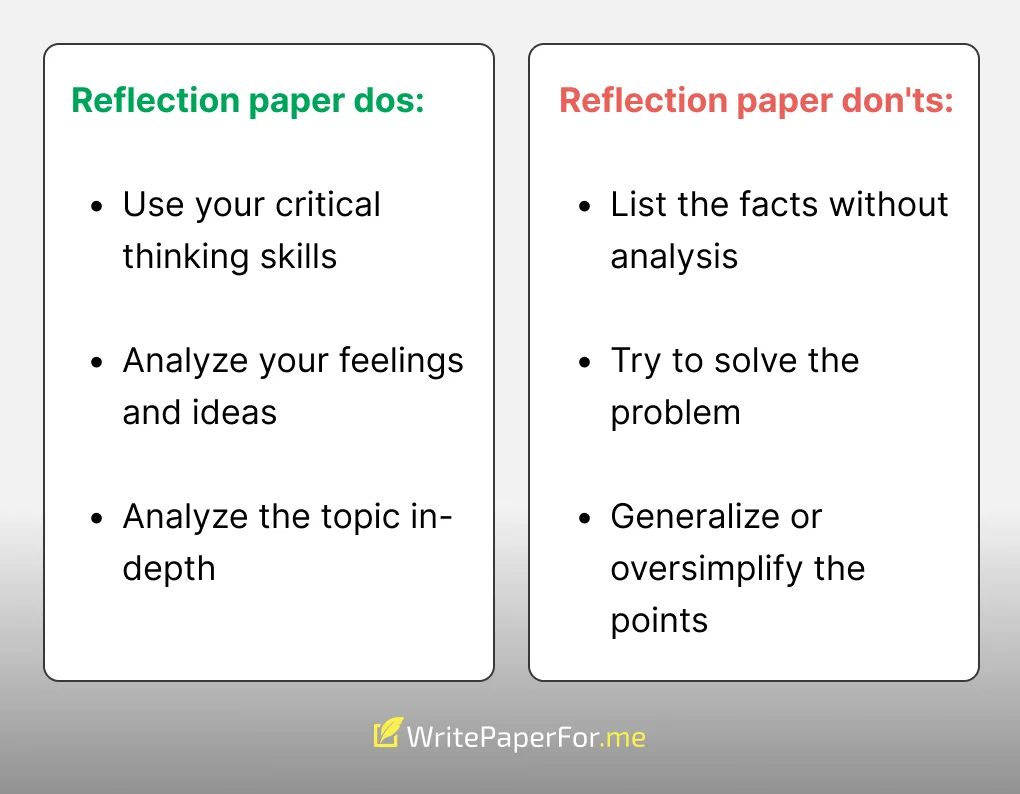
- Don't stop at describing what happened or summarizing what you read. Explain how your initial assumptions compare with what you understand now, why your perspective changed, and what questions remain. You can also consider another interpretation when it helps you evaluate your response more critically.
- Limit your paper's examples to avoid overwhelming the reader. Instead, select a few moving instances to show your thoughts. This chosen method lets you go deeper into each case and avoids a recap of events or readings.
- Make sure you use transition phrases and sentences that keep the essay parts logically connected.
6. Explain what you learned in the conclusion
Finally, it is time to sum up your ideas and explain how you might apply what you learned. Share the significance of the knowledge you gained for your understanding of the topic. However, make sure you do not mention any new information or ideas that have not been included in the body part.
7. Revise and proofread
Take a little break after you are done with the first draft and before you start revising the text. Check whether your examples support your thesis and whether the conclusion follows from the body.
If you receive feedback, use it to identify unclear arguments or gaps in your analysis. Think over this input and apply it to your revisions. Analyzing comments can help you develop as a reflective writer by revealing what works and what doesn't.
Re-read the paper and check it for grammar and punctuation mistakes, style issues, and formatting problems.

Short reflection paper example
This sample reflects on a peer review session in a college writing class.
What peer review taught me about giving feedback
Before our first peer review session, I thought helpful feedback meant catching as many errors as possible. I marked a classmate's comma errors and circled a few repeated words. Then she asked whether I could tell why her second example supported her argument. I couldn't answer. That question changed what I look for when I read someone else's draft.
I went back to the second example. It described a student who used a campus garden to meet people, but the paragraph never explained how meeting those people made the student feel more connected to campus. I underlined the sentence where I got lost and wrote down the question I had at that point. My classmate knew the answer right away, but she had assumed it was clear from the story. I realized that I made the same assumption in my own draft. I had included two examples of students sharing class notes without explaining what they showed about trust.
The session taught me to pay attention to what a reader can infer from the page. In the next peer review, I plan to read the full draft once and mark where I lose the argument before commenting on sentence-level errors. I'll do the same with my own work and check whether I've explained what each example shows.
Reflection paper format and types
Check your assignment guidelines for the required length, format, and tone. A formal reflection paper typically includes an introduction, body paragraphs, and a conclusion, but the length and structure may vary depending on the course and instructor's requirements.
Reflection papers commonly focus on two kinds of material:
- Experiential reflection. Examine a personal experience, practical activity, or event and explain what you learned from it.
- Textual reflection. Analyze your response to a book, article, or other assigned material, using specific passages or ideas to support your interpretation.
Adapt your approach to the subject. For example, a reflection on a scientific project may emphasize methods, results, and lessons learned, while a literary reflection may focus on how a text challenged or changed your interpretation.
Reflection paper topic ideas
A good reflection paper topic gives you an opportunity to examine a specific experience, explain your response, and identify what you learned or understood differently. Consider these examples:
- A conversation that changed how you understood someone else's perspective
- What a challenging group project taught you about teamwork
- How a book or article challenged one of your assumptions
- A mistake that changed the way you approach academic assignments
For more ideas and guidance on choosing a focused subject, explore our collection of reflective essay topics.
Final thoughts on writing a reflection paper
A strong reflection paper goes beyond describing an experience or summarizing a text. It explains what you thought, what challenged your perspective, and what you learned. Focus on a clear central insight, support your observations with specific examples, and show why the experience or reading matters to you.
If you need additional guidance with structure, revision, or formatting, a reflective essay writing service can provide academic support. Students who consider a write papers for me service should clearly communicate their assignment requirements and make sure their reflection preserves their own experiences and perspective.
Sources
- 1
Reflective Essays. (n.d.). George Mason University, Writing Center.
https://writingcenter.gmu.edu/writing-resources/different-genres/reflective-essays - 2
Critical Reflection: Journals, Opinions, & Reactions. (2025). Texas A&M University, Writing Center.
https://writingcenter.tamu.edu/guides/resources/critical-reflection.html - 3
Comparison Wrapper Reflection. (n.d.). Carnegie Mellon University, Eberly Center.
https://www.cmu.edu/teaching/designteach/teach/examwrappers/examwrappers-docs/paper-wrapper-reflection.pdf